In the field of interior design and building materials, the choice between semi-precious stone slabs and ordinary natural stones (such as marble and granite) often determines the final aesthetic and budget of a space. Although both originate from nature, they have fundamental differences in structure, performance, and aesthetic appeal.
The following are the five most significant differences between the two:
1. Structure and Manufacturing Process: Naturally formed vs. Handmade artistry
Ordinary natural stone (marble): This is rock that was originally present in the Earth's crust and formed through geological processes. Stone suppliers directly extract huge blocks from quarries and then cut them into large slabs. It is 100% pure, natural, solid rock.
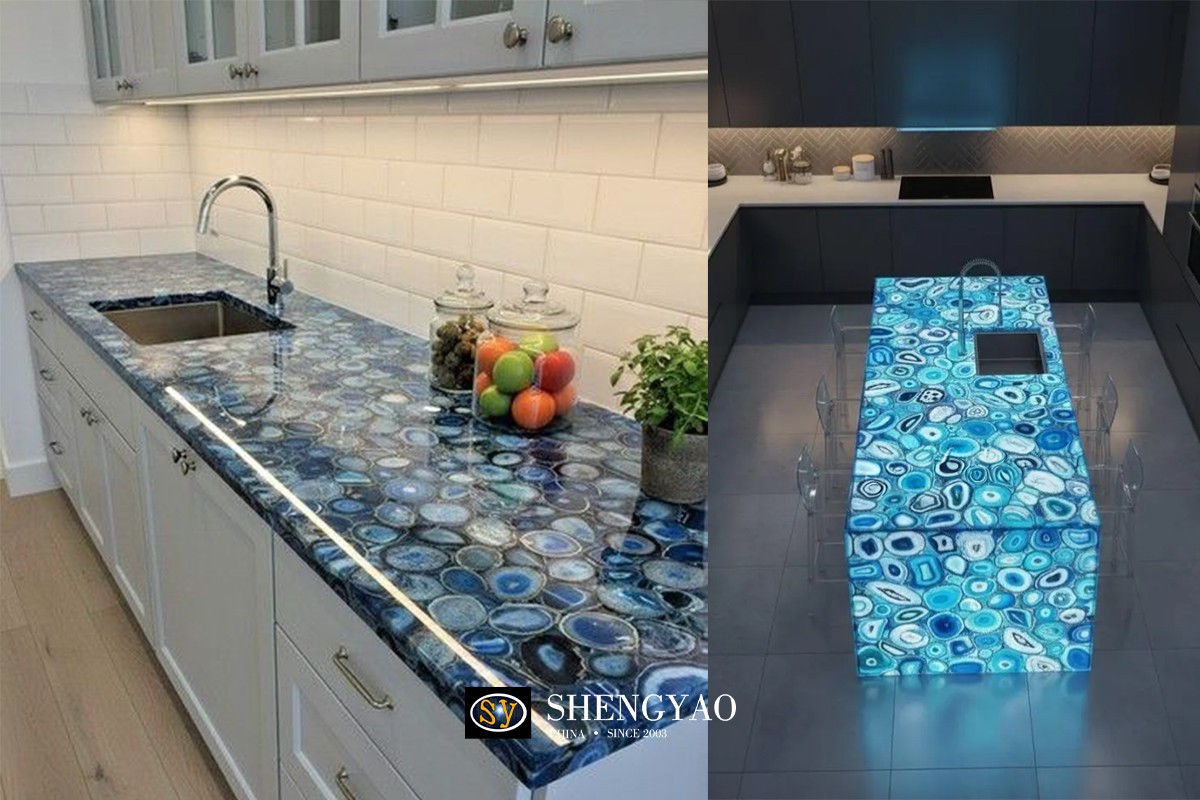
Semi-precious stone slabs: Although the raw materials (such as agate and crystal quartz) are natural, the slabs themselves are the result of artificial arrangement. Craftsmen cut gem-grade raw stones into thin slices or small pieces, bond them together with high-strength epoxy resin, and then polish them. It is more like an artistic collage composed of natural fragments.
2. Visual Effects and Translucency
Marble: Known for its elegant and natural veining, marble typically has soft color tones. Except for a very few varieties (such as white marble or some types of jade), most marble is opaque.
Semi-precious stone slabs: These feature extremely rich and striking colors (such as the deep blue of lapis lazuli or the emerald green of malachite). Their greatest physical characteristic is translucency. When LED light strips are installed behind the slab, the crystals and textures within the gemstone are "illuminated," creating a dreamlike, luminous effect that is impossible to achieve with ordinary marble.
3. Hardness and Durability
In mineralogy, we commonly use the Mohs hardness scale to measure hardness:
Marble (typical example: Carrara white) has a relatively low Mohs hardness, is easily scratched, and is susceptible to erosion by acidic substances.
Semi-precious stones (typical examples: agate and quartz) have extremely high Mohs hardness, and their scratch resistance far surpasses that of marble.
Note: Although semi-precious stones themselves are extremely hard, the resin used to bind them is sensitive to high temperatures. In contrast, while marble is more fragile, it has slightly better heat resistance.
4. Maintenance and Upkeep Costs
Marble: It is porous and easily stained (e.g., by red wine or coffee). It requires regular sealing and the use of specialized cleaning agents.
Semi-precious stone slabs: The surface is filled with resin, making it almost completely non-absorbent. Therefore, it has excellent stain resistance and will not develop "defects" or efflorescence like marble. The main maintenance point is to avoid contact with hot cookware to prevent the resin from melting or discoloring.
5. Rarity and Price Threshold
This is the most practical difference between the two:
Ordinary natural stone: The price range is very wide, from entry-level hundreds of yuan to high-end thousands of yuan per square meter.
Semi-precious stone slabs: These are considered luxury items. Because the raw materials themselves are minerals used in the jewelry industry, coupled with the extremely time-consuming manual installation process, their price is usually 5-10 times that of marble. They are typically used as a "finishing touch" in a space, such as for accent walls, bar counters, or as a surface for freestanding furniture.
How should I choose?
If you are looking for a classic, elegant, and large-scale application (such as flooring or bathroom walls) with a moderate budget, marble is the timeless choice.
If you are pursuing ultimate luxury, visual impact, or want to create a focal point with a backlit effect, semi-precious stone slabs will be the irreplaceable choice.